
eSIM vs Pocket WiFi: Which is Better?
At a glance
Compare eSIM vs Pocket WiFi by cost, convenience, battery and group travel scenarios.
TL;DR (Quick Summary)
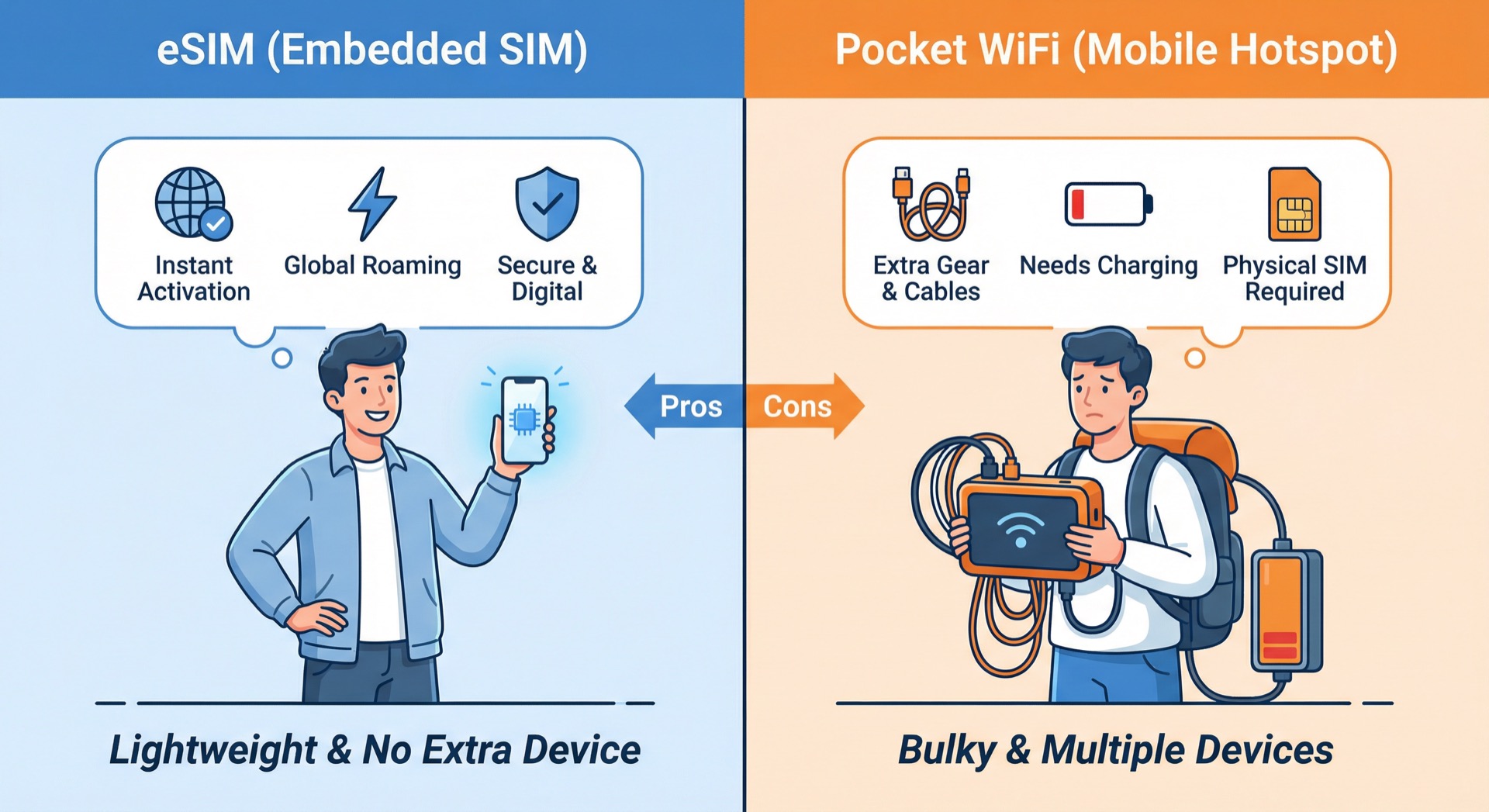
- 1-2 travelers + modern phone (eSIM supported): eSIM is generally most convenient and affordable.
- 3+ people + multiple devices simultaneously: Pocket WiFi is often more advantageous.
- Non-eSIM phone/tablet as main device: Pocket WiFi or local SIM card is more practical.
- Business trip + laptop required: eSIM tethering or Pocket WiFi (depending on situation)
Why This Comparison Matters
One of the most common questions when preparing for international travel is "How should I handle data?" In the past, pocket WiFi was almost the only option, but with the recent popularization of eSIM, choices have diversified.
Consequences of wrong choice:
- Rent pocket WiFi then fail battery management → Internet disconnects at critical moments
- Buy eSIM then discover tethering not allowed → Can't use laptop
- Each family member buys eSIM → Excessive costs
- Rent pocket WiFi for solo travel → Unnecessary baggage and costs
Through this guide, you can make the optimal choice for your travel style.
8 Detailed Comparison Criteria
1. Cost Comparison
eSIM
Pricing structure:
- Fixed price by duration/capacity
- Japan 7 days 5GB: approximately $8-15
- Europe 10 days 10GB: approximately $15-27
Additional costs:
- None (when purchased online)
- Additional data purchase available (depending on provider)
Total cost (Japan 7 days, 2 people):
- Each 7GB plan: $23-31
Pocket WiFi
Pricing structure:
- Daily rental fee: approximately $4-8/day
- Deposit: $38-77 (refunded upon return)
- Shipping: $1.5-2.3 (round trip)
- Extension fee: daily rental fee + additional costs
Additional costs:
- Loss/damage: deposit deduction or additional costs
- Late fee: when return is delayed
- Spare battery: $8-15 (optional)
Total cost (Japan 7 days, 2 people):
- Basic rental: $27-54
- Shipping: $1.5-2.3
- Spare battery: $8 (optional)
- Total: $36-64
Conclusion: 1-2 travelers: eSIM is cheaper, 3+ people: depends on situation
2. Convenience (Pickup/Return/Mobility)
eSIM
Purchase:
- Online purchase → QR code received via email
- Time required: instant~several hours
Installation:
- Scan QR code on Wi-Fi (5-10 minutes)
- Can complete at home before departure
Usage:
- Connect immediately upon airport arrival
- No separate device needed
- No risk of loss
Return:
- None
Pocket WiFi
Pickup:
- Airport counter pickup: queuing, business hours limitation
- Delivery pickup: must receive day before departure, problems if absent
Usage:
- Must carry at all times
- Battery management required (4-8 hours per day)
- Charging cable essential
- Risk of loss
Return:
- Airport counter return: must find location upon return
- Delivery return: must send same day or next day after return
Conclusion: eSIM is overwhelmingly more convenient
3. Battery and Heat Management
eSIM
Battery:
- Only manage smartphone battery
- Normal use: charge once per day
- With tethering: increased battery consumption (2-3 charges per day)
Heat:
- Increased heat when tethering
- Long-term tethering not recommended
Power bank:
- One smartphone power bank is sufficient
Pocket WiFi
Battery:
- Manage dedicated pocket WiFi battery
- Continuous usage time: 4-8 hours (varies by device)
- Need to charge 1-2 times per day
Heat:
- Heat generation during long usage
- Risk of overheating if kept on in bag
Power bank:
- Need spare battery for pocket WiFi ($8-15)
- Or charge with power bank
Conclusion: eSIM has fewer management points
4. Multiple Device Sharing
eSIM
Tethering (hotspot):
- Set smartphone as hotspot
- Simultaneous connections: usually 5-10 devices (varies by device)
- Practical connections: 2-3 devices recommended
Disadvantages:
- Rapid smartphone battery drain
- Smartphone heat generation
- Some plans block tethering (must check before purchase)
Suitable for:
- Occasional laptop/tablet connection
- Short-term use
Pocket WiFi
Simultaneous connections:
- Usually 5-10 devices can connect simultaneously
- Practical connections: 3-5 devices
Advantages:
- Optimized for multiple device simultaneous use
- No impact on smartphone battery
- Stable connection
Suitable for:
- Family/group travel
- Multiple devices always connected
- Heavy laptop work
Conclusion: Pocket WiFi is better for multiple device sharing
5. Speed and Stability
eSIM
Speed:
- Direct use of local carrier network
- 4G/5G speed (depending on plan)
- Generally fast and stable
Stability:
- Depends on carrier network quality
- Signal may be weak underground/indoors
Pocket WiFi
Speed:
- Uses local carrier network then retransmits via WiFi
- 4G/LTE speed (most)
- Speed distributed when multiple devices used simultaneously
Stability:
- Depends on device condition
- Disconnects when battery low
- Performance degradation when device overheats
Conclusion: eSIM is slightly faster and more stable
6. Data Capacity and Policies
eSIM
Capacity options:
- Various from 1GB to unlimited
- High-speed + unlimited low-speed plans popular
- Wide selection by plan
Speed policies:
- Low speed after high-speed capacity exhausted (128kbps~512kbps)
- Daily limit plans
- Completely unlimited plans
Pocket WiFi
Capacity options:
- Unlimited plans are common
- Some have daily limits (e.g., 1GB per day)
Speed policies:
- FUP (Fair Usage Policy) applied
- Speed limit possible with excessive use
Conclusion: Both similar, depends on plan
7. Loss/Damage/Security Risks
eSIM
Loss:
- No physical device so no risk of loss
- Problem only if smartphone is lost
Damage:
- No separate device so no risk of damage
Security:
- Only use personal device
- No need to share password
Pocket WiFi
Loss:
- High risk of loss due to small device
- Deposit deduction or additional costs if lost
Damage:
- Can be damaged by shock, water, overheating, etc.
- Repair costs or deposit deduction if damaged
Security:
- Security risk when sharing WiFi password
- Others can connect without permission in public places (if password exposed)
Conclusion: eSIM has lower risk
8. Country/Region Coverage
eSIM
Regional plans:
- Single country plans
- Regional plans (e.g., 30 European countries, 10 Asian countries)
- Global plans (100+ countries)
Advantages:
- Convenient for multi-country travel
- Automatic switching when crossing borders
Pocket WiFi
Regional rental:
- Usually single country or regional
- Some devices support multiple countries
Advantages:
- Optimized for specific countries
Conclusion: eSIM is more convenient for multi-country travel
Recommendations by Situation (Real Scenarios)
Scenario 1: Solo or Couple Travel (2 people)
Travel info:
- Tokyo, Japan 5 days
- Each has smartphone (eSIM supported)
- No laptop
Recommendation: eSIM (each purchase)
Reasons:
- Cost: Each $8-12 = $16-24
- Pocket WiFi: approximately $31-46
- Convenience: No pickup/return
- Can use internet separately when traveling apart
Plan selection:
- Each 5-7GB plan
- Or high-speed 3GB + unlimited low-speed
Scenario 2: Family Travel (2 parents + 2 children)
Travel info:
- Osaka-Kyoto 7 days
- Parents: smartphone (eSIM supported)
- Children: elementary school, no smartphone or eSIM not supported
Option A: Each parent eSIM + tethering
- Cost: $23-31
- Children connect to parent hotspot
- Suitable when always traveling together
Option B: 1 Pocket WiFi
- Cost: $35-46
- Whole family connects
- Inconvenient when traveling separately
Option C: 1 parent large capacity eSIM + tethering
- Cost: $19-27 (15-20GB plan)
- Most affordable
- 1 person bears battery management burden
Recommendation: Option A or C
Scenario 3: Group Travel (5 friends)
Travel info:
- Europe 10 days
- All have smartphones (eSIM supported)
- Occasionally travel separately
Option A: Each eSIM
- Cost: 5 people × $23 = $115
- Can travel freely
- Each manages own data
Option B: 1-2 Pocket WiFi
- Cost: 1 device $62-92
- Or 2 devices $124-185
- Can only connect when traveling together
Recommendation: Option A (each eSIM)
- Group travel often involves separate movement
- Each eSIM provides more freedom
Scenario 4: Business Trip (1 person, laptop required)
Travel info:
- Paris 10 days
- Smartphone + laptop
- Many video conferences, email work
Option A: Large capacity eSIM + tethering
- Cost: $31-46 (20-30GB or unlimited)
- Must be tethering-allowed plan
- High smartphone battery consumption
Option B: Pocket WiFi
- Cost: $54-77
- Stable laptop connection
- No impact on smartphone battery
Option C: eSIM + local cafe/hotel WiFi
- Cost: $15-23 (eSIM only)
- Work on WiFi
- Only smartphone while moving
Recommendation: Option A or C
- Option A: Can work without location constraints
- Option C: Cost savings, utilize WiFi
Scenario 5: Long-term Stay (30 days)
Travel info:
- Tokyo, Japan 30 days
- Digital nomad
- Constant laptop use
Option A: eSIM unlimited
- Cost: $46-77
- Convenient but expensive
Option B: Local SIM (physical SIM)
- Cost: $23-38 (local carrier plan)
- Most affordable
- Can't receive domestic number (possible with dual SIM)
Option C: Long-term pocket WiFi rental
- Cost: $77-138
- Expensive
Recommendation: Option B (local SIM)
- Long-term stay: local plan is most economical
Selection Guide (Checklist)
Find the right option for you by answering these questions.
Step 1: Basic Information
- How many people are traveling?
- How many days is the trip?
- Does everyone have eSIM-supported devices?
Step 2: Usage Patterns
- How many devices need internet? (phone/tablet/laptop)
- Will you always travel together or separately?
- Will you use laptop frequently?
- Will you do a lot of video streaming/video conferencing?
Step 3: Priorities
- Is cost most important?
- Is convenience most important?
- Is stability most important?
Result Interpretation
eSIM recommended conditions:
- 1-2 person travel
- eSIM-supported devices
- Prioritize convenience
- Cases of traveling separately
Pocket WiFi recommended conditions:
- 3+ person group
- Need multiple device simultaneous connection
- Always travel together
- Have non-eSIM devices
Local SIM recommended conditions:
- Long-term stay (30+ days)
- Cost is top priority
- Don't need domestic number (or use dual SIM)
Practical Tips
Precautions When Choosing eSIM
- Check tethering policy: Purchase tethering-allowed plan if laptop connection needed
- Calculate data capacity: Refer to Data Capacity Guide
- Carrier unlock: Must check before purchase
- Check activation timing: Upon purchase/upon installation/upon local connection
Precautions When Choosing Pocket WiFi
- Prepare spare battery: Essential for all-day use
- Check pickup/return hours: Airport counter business hours
- Consider insurance: Prepare for loss/damage risk
- Pack charging cable: Check USB type
Cost Saving Tips
- Early booking discount: Discount when purchasing 2-4 weeks before departure
- Use promotions: Seasonal discounts, coupons
- Group discount: Discount for group purchase (some vendors)
- Long-term discount: 15+ day plans have lower daily rates
Frequently Asked Questions (FAQ)
Q1. Can I use eSIM and pocket WiFi simultaneously?
A: Yes, it's possible.
- eSIM: Personal smartphone data
- Pocket WiFi: Laptop/tablet connection
- Double backup effect
However, it costs double and is inefficient.
Q2. If multiple people split pocket WiFi costs, is it cheaper than eSIM?
A: From 3+ people, it can be.
Example (Japan 7 days):
- Pocket WiFi: $38 ÷ 4 people = $9.5/person
- eSIM: $12/person
However, you must consider inconvenience when traveling separately.
Q3. eSIM tethering vs pocket WiFi, is there a speed difference?
A: Similar or eSIM is slightly faster.
- eSIM tethering: Carrier → Smartphone → WiFi → Laptop
- Pocket WiFi: Carrier → Pocket WiFi → WiFi → Laptop
eSIM has one less intermediate step so theoretically faster, but in actual use there's almost no noticeable difference.
Q4. Does pocket WiFi battery last all day?
A: Varies by device but usually 4-8 hours.
- Continuous use: 4-6 hours
- Intermittent use: 6-8 hours
Spare battery is essential for all-day use.
Q5. Can't eSIM be shared among multiple people?
A: Sharing via tethering is possible but has limitations.
- Rapid smartphone battery drain
- Smartphone heat generation
- Some plans block tethering
Sharing among 2-3 people for short periods is possible, but pocket WiFi is better for long-term/many people sharing.
Q6. What happens if I lose the pocket WiFi?
A: Deposit is deducted or additional costs occur.
- Full deposit deduction: $38-77
- Or device price charged: $77-154
Consider purchasing loss insurance when renting (additional $0.4-0.8 per day).
Q7. Both have pros and cons, how do I decide?
A: Set your priorities.
Cost first priority:
- 1-2 people: eSIM
- 3+ people: Compare and choose
Convenience first priority:
- eSIM (no pickup/return)
Multiple device sharing essential:
- Pocket WiFi
Travel separately often:
- Each eSIM
Next Steps
Once you've made your choice, start concrete preparation.
If eSIM chosen
- Travel Data Capacity Selection Guide
- How to Install eSIM on iPhone
- How to Install eSIM on Android
- Recommended eSIM for Japan Travel
If Pocket WiFi chosen
- Compare rental companies (price, reviews, insurance)
- Check pickup/return methods
- Prepare spare battery
- Pack charging cable
Additional Information
Last Updated: February 20, 2024
Author: eSIMoa Guide Team
